Commercial roofing for Long Island businesses
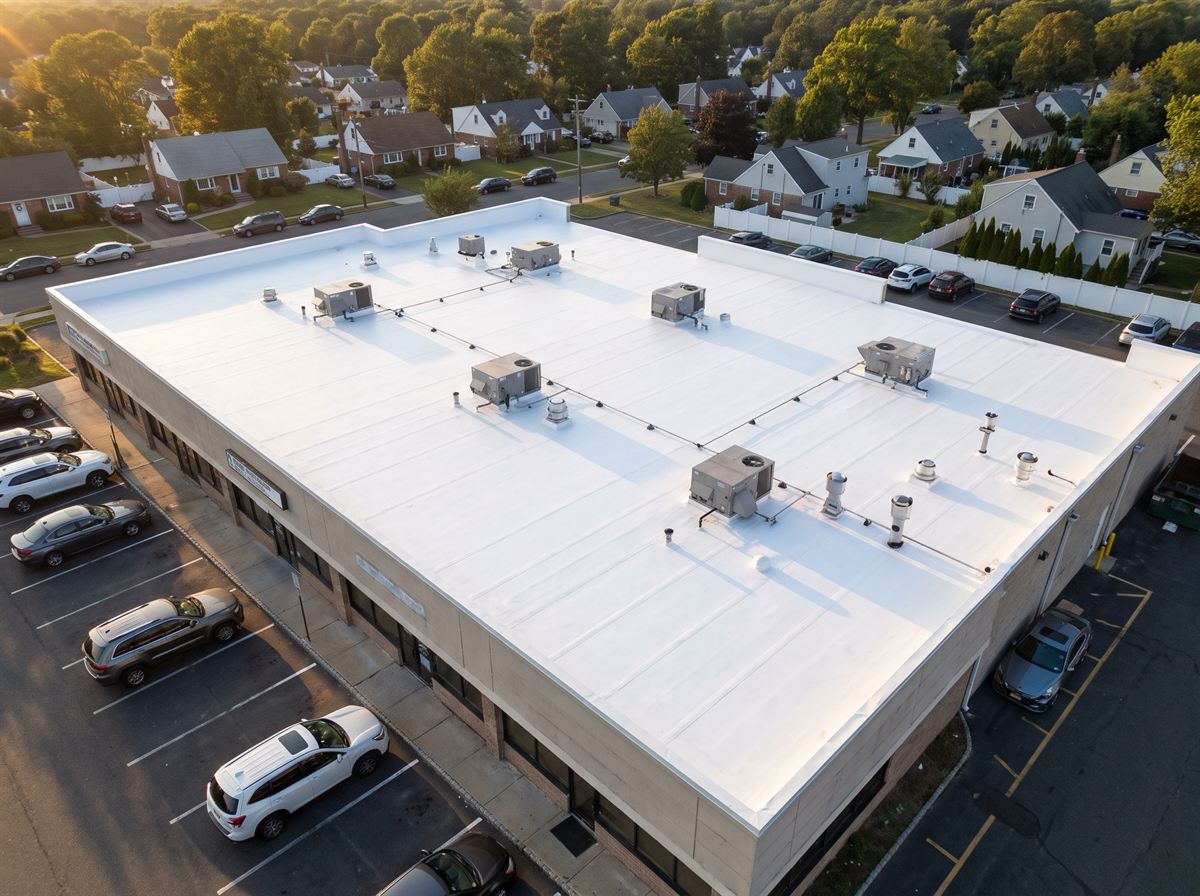
We work on low-slope roofs for shops, warehouses, medical offices and multi-family buildings across Suffolk and Nassau. We replace, re-cover and repair TPO, EPDM and modified bitumen systems. You deal with one person. David handles your proposal and the schedule, and he's the one you call from the first walk-through to the final inspection. Work is scheduled around your tenants and your hours.

GAF Master Elite® CertifiedFewer than 3% of roofing contractors nationwide. Verify contractor ID 1135609 on GAF

BBB Accredited BusinessA+ rating from the Better Business Bureau. See our BBB profile.
What's included
- Flat and low-slope systems: TPO, EPDM and modified bitumen
- Full replacement, re-cover over a sound existing roof, and repair
- Tapered insulation, drains, scuppers and rooftop-unit flashing
- Leak diagnosis with a written findings report
- Scheduled maintenance plans for property managers
- Work scheduled around business hours, tenants and deliveries
Commercial roofs fail at seams, drains and penetrations, not in the middle of the field. We build slope into the insulation so water leaves the roof. Every joint gets heat-welded or seam-taped, and we flash every curb, pipe and HVAC unit before signing off. As a GAF Master Elite contractor, we can install GAF commercial systems to the manufacturer's specification. That's what qualifies a roof for their enhanced commercial warranties.
L.I. Taylor Construction is a GAF Master Elite® contractor (ID 1135609), licensed in Suffolk County (HI-64134), Nassau County (196461) and New York City (2114459-DCA), and fully insured. It is a BBB Accredited Business with an A+ rating. Financing is available for qualifying projects.
How a commercial roofing job goes
Walk-through and core samples
We inspect the roof, check the deck and any wet insulation, and photograph the trouble spots. On older roofs, we take core samples so you know exactly how many layers are up there.
Written proposal, not a guess
Your written scope names the system, insulation thickness, drainage plan, warranty and schedule. It's ready to go into a board packet or an RFP comparison.
Scheduling around the building
We plan loading, tear-off and crane time around deliveries, tenant hours and parking. We group noisy work to keep disruption short.
Tear-off or re-cover
We remove and dispose of wet or failed material. Where the existing roof is dry and sound, a re-cover saves the cost and mess of a full tear-off.
Insulation, membrane, details
We set tapered insulation to the drains and lay the membrane. Every seam is welded and probed. Curbs, pipes, edges and drains get flashed last. That's where roofs leak.
Final inspection and paperwork
We walk the finished roof with you and hand over the warranty registration and photos. And if you want a maintenance schedule, we set that up too.
Systems we install
What affects the cost
We price every commercial roof from its own measurements and conditions. We don't publish a per-square price. These factors move the number most:
- Square footage and how many roof layers must come off. Tear-off and disposal make up a large part of a full replacement.
- Whether a re-cover is possible. If the existing roof is dry, a re-cover avoids most of the tear-off labor and dumpster cost.
- Insulation. Building code requires a minimum R-value on replacement, and tapered insulation to fix ponding adds material.
- Rooftop equipment. Every HVAC unit, vent, skylight and drain needs its own flashing detail.
- Access and staging. Crane time, roof height and where the dumpster can sit affect labor.
- Warranty level. A manufacturer-backed system warranty has stricter material and inspection requirements than a contractor workmanship warranty.
The only way to get a real number is a free on-site estimate. Request one below or call 631-404-9022. Your call goes straight to David, and the estimate is in writing.
Related services and nearby towns
Often done together
Where we do this work
Commercial roofing questions we hear most
How long does a commercial flat roof last on Long Island?
A properly installed TPO or EPDM roof typically lasts 20 to 30 years here. Modified bitumen typically lasts 15 to 25 years. Salt air on the South Shore shortens that life, as do ponding water and neglected drains; regular maintenance extends it. Most premature failures we see are at seams and flashings, not in the membrane itself.
Can you replace a commercial roof without closing the business?
Usually, yes. We work in sections and keep entrances clear. Tear-off and crane lifts are scheduled for early mornings or off-hours, and tenants get the schedule in advance so noise and parking aren't a surprise.
Do I need to tear off the old roof or can it be re-covered?
If core samples show dry insulation and a sound deck, and there's only one roof in place, a re-cover is often the better value. If there are already two roofs, or the insulation is wet, code and common sense both call for a full tear-off.
Will a white TPO roof actually lower cooling bills?
On a single-story building with the roof over conditioned space, a reflective white TPO membrane measurably reduces roof surface temperature in July and August. That reduces the load on rooftop air conditioning. Savings are smaller on well-insulated buildings and on multi-story buildings where the roof makes up a small share of the envelope.
Get a free estimate
Tell us about the job and David will call you back, usually the same day. No pressure, no obligation, and financing is available for qualifying projects.
631-404-9022Open every day, 8AM–6PM